Risk Review: Planning product inspections in China
Inspection can reduce uncertainty, but it also has limits: a sample may miss defects, an inspection may happen too late for correction, or a report may not cover the buyer’s actual concern. Review product, supplier, process, timing, and evidence risks together before deciding what to inspect, who should do it, and what result should block shipment.
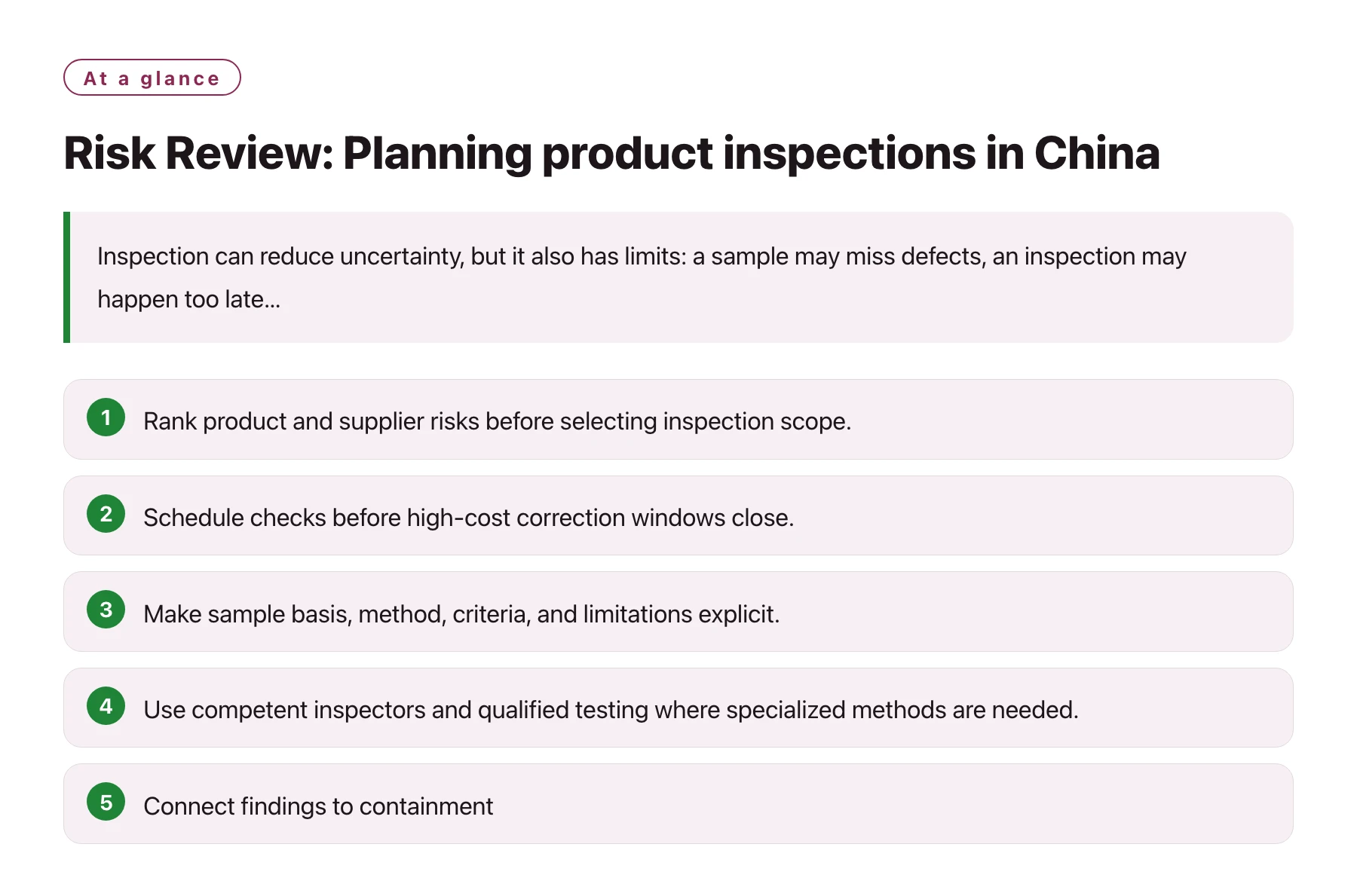
Key takeaways
- Rank product and supplier risks before selecting inspection scope.
- Schedule checks before high-cost correction windows close.
- Make sample basis, method, criteria, and limitations explicit.
- Use competent inspectors and qualified testing where specialized methods are needed.
- Connect findings to containment, corrective action, and authorized release.
A risk review makes inspection proportional to the likely harm and ensures that results can still influence the order outcome.
1. Define the decision and consequence of error
State what decision the inspection supports: supplier selection, production correction, lot acceptance, packaging approval, or shipment release. Identify the potential consequence of a wrong decision, including safety, regulatory, fit, function, rework, customer, or schedule impact.
Separate critical acceptance criteria from preferences. A defect that affects product safety or a required market condition needs a different escalation path from a minor cosmetic issue. Assign technical and regulatory owners for questions outside routine visual inspection.
2. Review supplier and product history
Examine prior inspection reports, incoming defects, complaints, rework, delivery performance, corrective-action closure, and changes in site or process. Confirm that history relates to the same factory, product family, revision, and method. Do not rely on an overall supplier score that hides a weak product line.
New products, new sites, new processes, repeated defects, poor traceability, and late specification changes can justify stronger controls. Stable history may support a different plan, but any reduction should follow defined criteria and documented approval.
3. Identify where defects can be created or escape
Map materials, process steps, assembly, finish, testing, packaging, and shipment handoffs. List failure modes and the point at which each can be prevented, observed, or corrected. Focus attention where defects are hard to detect later or can affect many units before discovery.
Check dependence on subcontractors, special materials, equipment, operator skill, software, or setup. Determine how changes are controlled and how affected lots are identified. The risk review should include process drift and mislabeling, not only visible finished-product defects.
4. Choose timing that leaves room to act
Compare pre-production, first-off, during-production, final inspection, and loading checks. Earlier review can catch setup or material issues before a large run, while final inspection evaluates selected finished units and packing. Choose stages that match the failure mode and the buyer’s correction options.
Set visit triggers based on production readiness, quantity complete, lot availability, and report deadline. Identify the last practical correction point before booking or dispatch. A check scheduled after the goods are inaccessible or already loaded may document a problem without leaving a viable remedy.
5. Set sampling and method limits
Define lot, selection method, quantity, inspection level, acceptance criteria, test method, instruments, and units. For attributes inspection, ISO 2859-1:2026 provides AQL-indexed sampling procedures when its scope and contractual use are appropriate. The chosen plan affects decision risk and does not guarantee every unit is defect-free. [1]
Do not use a generic sample size for every characteristic. Hidden properties, safety-critical performance, material composition, or specialized claims may need different tests or a qualified laboratory. State which characteristics are not covered and how uncertainty will be managed.
6. Assess inspector competence and independence
Match inspector experience to product complexity, test method, language, and factory process. Confirm equipment needs, calibration status, safety access, confidentiality, and reporting expectations. Use a laboratory or technical specialist when the inspection requires expertise or instruments beyond a general visit.
Clarify whether the inspector is independent, employed by a provider, or supplied by the factory. Disclose relationships or conflicts that could affect the decision. The buyer should retain the release authority unless explicitly delegated under a controlled arrangement.
7. Review criteria and evidence quality
Provide current drawings, approved samples, packaging rules, labels, and market requirements. Make sure the supplier and inspector use the same revisions. Define how borderline results are recorded and who decides whether an exception is acceptable.
Require report identity for supplier, site, product, order, revision, lot, date, method, sample basis, results, photos, and limitations. A simple “pass” without scope or evidence can conceal that a key item was unavailable, untested, or substituted.
8. Plan containment and decision escalation
Before the visit, define the actions for critical, major, and minor findings, including hold, segregation, sorting, correction, replacement, retest, or concession. Identify who contacts the factory and buyer, how quickly, and what evidence is required to close an issue.
A concession should identify affected quantity, risk rationale, approval authority, customer or regulatory authorization where needed, and expiry or scope. Do not convert an unresolved critical defect into an accepted lot merely to protect a shipping date.
9. Connect inspection status to logistics
Ensure freight booking and warehouse teams can see shipment holds and release status. Reconcile inspection lot, packing list, carton count, container number, and seal record. If goods or packaging change after inspection, reassess whether the previous result still applies.
Keep inspection evidence with the purchase order, commercial documents, and shipment file. Ensure any required correction or retest is complete before the person with release authority approves dispatch.
10. Learn from actual defects and outcomes
Compare inspection results with destination receiving, complaints, returns, and damage. Determine whether the issue was detectable within the original scope and whether the timing allowed action. Review false alarms, missed findings, and repeated defects without assuming every failure was inspector error.
Buyers evaluating China inspection services can combine risk review, inspection coordination, and supplier follow-up around documented criteria. Update frequency and methods when evidence, product risk, process stability, market, or supplier performance changes.
Sources
Frequently asked questions
Does more inspection always mean lower risk?
Not necessarily. Match scope, sample, timing, method, and action path to the failure modes that matter.
Can a final inspection fix a production defect?
It can identify selected findings; correction may require rework, replacement, retesting, or a revised schedule.
Does an AQL plan guarantee zero defects?
No. It defines a sampling decision under specified assumptions and does not test every unit.
Who should decide shipment release after a failure?
The named buyer authority should review findings, corrective evidence, and any approved concession before release.